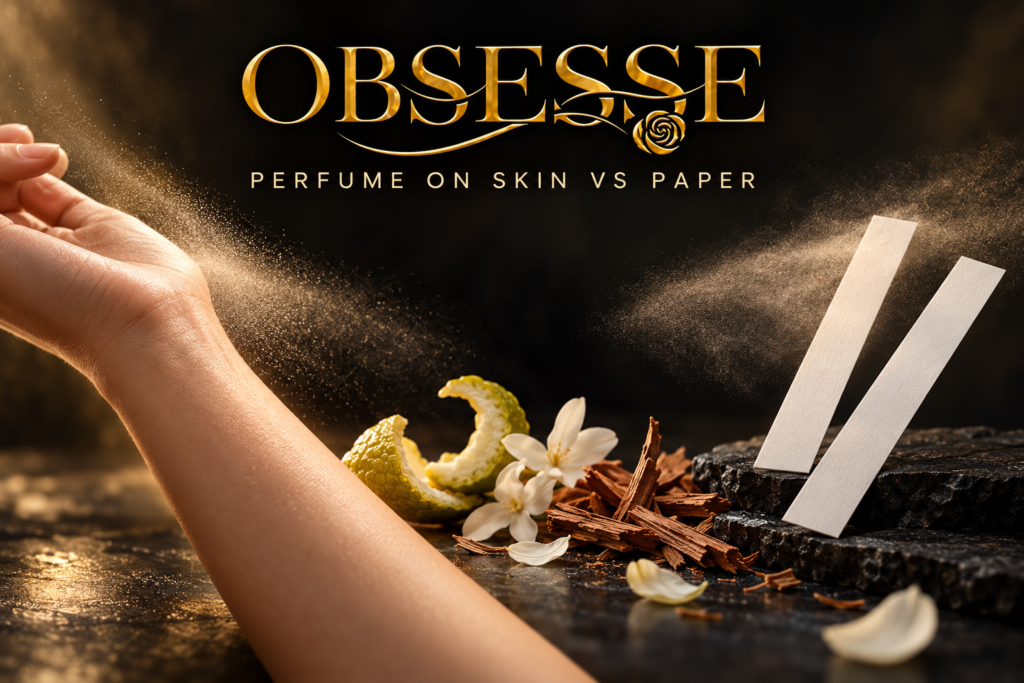
The most useful places to apply perfume are clean skin on the wrists, the sides or base of the neck, and the inner elbows. These areas are easy to reach and let the fragrance develop close to your body. You do not need to spray every pulse point: choose one or two areas, use a modest amount, and adjust only after observing the scent in your real routine.
That is the short answer to where to apply perfume. The better answer depends on whether you want a quiet personal scent, a noticeable trail, comfortable office wear, or longer presence on clothing. Indian heat, humid commutes and air-conditioned interiors also make context important. This guide explains the practical options without treating one application method as universally correct.
Why application location matters
The same fragrance can feel different depending on where and how it is applied. On skin, it develops with body warmth and your individual skin environment. On clothing, it may remain more consistent because it is not interacting with skin in the same way. Application height and movement also influence how easily you and people nearby notice it.
Location is only one part of performance. Formula, concentration, number of sprays, weather, distance and your own perception all matter. Applying to more places does not automatically make a perfume better or more refined; it usually makes the total scent more noticeable.
The official Aesop fragrance guide identifies the wrists and neck as commonly recommended pulse points and advises testing a fragrance on your own body on different occasions. Diptyque’s official application guidance similarly lists the neck, wrists and crook of the arm. These are useful starting points, not a rule that every fragrance must be worn in all three places.
1. Wrists: convenient for checking the scent
The wrists are popular because they are easy to reach and easy to smell during the day. One light application to a wrist gives you a convenient way to follow the opening, heart and drydown without bringing your nose close to your neck.
Wrists also come into frequent contact with desks, sleeves, watches, handwashing and sanitiser. That makes them less ideal if you want the application to remain undisturbed for hours. If you wash your hands often, use an inner elbow or the base of the neck instead of automatically reapplying every time the wrist scent becomes faint.
For a controlled comparison, apply one fragrance to each wrist and let both dry naturally. Avoid mixing them with fragranced hand cream while testing. Our guide to testing perfume before buying explains how to compare the full wear rather than judging only the first spray.
2. Sides or base of the neck: noticeable without using many areas
The sides or base of the neck are practical when you want the fragrance near the upper body. This position can make the scent easier to notice as you move, especially when the neckline is open.
Apply from the distance stated on the product directions, and keep the spray away from the face and eyes. If you shave the neck or have irritated skin, wait until the area is comfortable or choose another location. More sprays around the neck can quickly become overwhelming because the fragrance sits close to your nose throughout the day.
For shared transport, classrooms, clinics and offices, start conservatively. You can always use a little more on another day, but reducing an over-applied perfume after leaving home is difficult.
3. Inner elbows: useful when wrists are frequently washed
The inner elbows, sometimes called the crooks of the arms, are another commonly suggested area. They are relatively protected from handwashing and can work well when you wear short sleeves or loose clothing.
This location is not automatically “stronger” than the wrist. It is simply a practical alternative that experiences movement and is less likely to rub against a watch or desk surface. Avoid applying on broken, freshly shaved or irritated skin, and follow any warnings printed on the perfume packaging.
4. Behind the ears: a close, personal option
Behind the ears can create a close scent around the head and neckline. Use a small amount because the position is near your nose and near people who may greet or sit close to you.
Take care with earrings, hearing devices and recently treated or sensitive skin. Do not spray directly toward the ear canal. If the atomiser is difficult to control, apply to a lower part of the neck instead.
Skin versus clothes: which is better?
Neither is always better. Skin shows how the fragrance develops on you; clothes may hold the aroma differently and can make it easier to notice on fabric later. The choice should depend on the product instructions, material and effect you want.
| Application | Useful for | Important caution |
|---|---|---|
| Wrists | Monitoring the scent during the day | Handwashing, watches and sleeves may disturb it |
| Neck | Upper-body presence with few application points | Keep away from face, eyes and irritated skin |
| Inner elbows | An alternative to frequently washed wrists | Avoid broken or sensitive skin |
| Behind ears | A close, personal scent effect | Use sparingly and avoid the ear canal |
| Clothing | A more fabric-centred scent trail | Test an inconspicuous area for marks or colour change |
Can you spray perfume on clothes?
Many people do, and some fragrance houses describe clothing application as an option. However, perfume contains materials that may not suit every fabric, dye or finish. Delicate, light-coloured, embroidered or expensive garments deserve particular care.
Check the product directions first. If clothing application is allowed, test a hidden area and let it dry before deciding. Spray from a reasonable distance rather than soaking one spot. Do not apply directly to jewellery, watches, leather accessories or polished surfaces unless the maker specifically says it is safe.
Clothing application should not replace testing on skin when you are deciding whether to buy a perfume. Skin wear tells you how the fragrance feels close to your body, while fabric wear answers a different question.
Should you apply perfume to hair?
Use a hair perfume or hair mist if the product is specifically designed and labelled for that purpose. Diptyque’s guidance, for example, distinguishes hair perfume from standard eau de toilette or eau de parfum. Follow the directions for that exact product.
Avoid spraying a standard perfume toward your face or eyes in an attempt to scent your hair. Do not assume that every alcohol-based fragrance is intended for direct use on the scalp or hair. A scarf or clothing application—when permitted by the label and fabric—can be a more controlled alternative.
What about chest, torso and lower body?
The chest or upper torso can create a scent that stays closer to the wearer, particularly under clothing. This can be useful when you want a private effect rather than a strong trail. Apply only to intact skin and allow the area to dry before dressing.
Lower-body application is sometimes used because movement can release scent from clothing, but it is rarely necessary for everyday wear. Start with one or two upper-body locations. Add another area only if repeated wear shows that the fragrance is genuinely too quiet for your intended setting.
How to apply perfume step by step
- Begin with clean, dry skin. Strongly fragranced body products can make it harder to judge the perfume itself.
- Choose one or two locations. Wrists, neck or inner elbows are sensible starting points.
- Follow the bottle directions. Spray distance and intended use can vary by product.
- Let the application dry. For consistent testing, avoid rubbing or immediately covering the wet area.
- Wait before adding more. The opening can be brighter and more noticeable than the later stages.
- Check the scent in context. Consider how it feels during your commute, workday or event—not only in front of a mirror.
- Record what worked. Note the locations and number of sprays so you can repeat or adjust the result.
Adjusting application for Indian weather and daily life
India includes very different climates, so a fixed “summer rule” cannot fit everyone. A humid coastal day, a dry northern summer, a monsoon commute and an air-conditioned office create different experiences. Your clothing, travel method and time outdoors matter too.
On warm days, begin with fewer application points and evaluate after you have been outside. In an air-conditioned environment, remember that people may sit close together even if the scent seemed light during the commute. For an outdoor evening event, a slightly broader application may feel appropriate, but test it first rather than increasing automatically.
Application should also match the setting:
- Office or classroom: one or two discreet points are usually easier to manage.
- Public transport: avoid creating a large scent cloud immediately before boarding.
- Celebration or outdoor event: test a slightly more noticeable application on a previous day.
- Close dinner or meeting: favour personal wear over strong projection.
For shared workspaces, our office perfume etiquette guide offers more detail.
Application does not guarantee longevity
A perfume disappearing from your attention does not always mean it has vanished for everyone else. You may become less aware of a familiar smell, while someone at a different distance can still notice it. Ask a trusted person before reapplying in a shared setting.
It also helps to separate three ideas: longevity is how long the fragrance remains detectable, projection is how far it seems to radiate, and sillage is the trail it leaves. Application location influences the experience, but it cannot turn every formula into a long-lasting, high-projection scent. See our guide to projection, sillage and longevity for a practical testing method.
Concentration labels are not complete performance guarantees either. An Eau de Parfum is not automatically the best choice for every person or setting. Our EDP vs EDT vs Parfum comparison explains why real wear matters.
Common application mistakes
- Spraying every pulse point at once: this makes it hard to learn what amount actually works.
- Reapplying too quickly: give the fragrance time to move beyond its opening.
- Spraying toward the face: keep perfume away from eyes and follow label warnings.
- Ignoring fabric compatibility: test clothing discreetly before visible application.
- Using ordinary perfume as hair mist: use a product intended for hair instead.
- Changing multiple variables: keep the spray count steady when comparing locations.
- Assuming more means longer: extra volume often increases intensity more than useful wear time.
Try the method before committing to a full bottle
A smaller format makes it easier to test one fragrance on wrists, neck and clothing across separate days. Obsesse Fragrance currently lists an 8 ml single tester bottle and an 8 ml five-piece tester option. Review the live pages for current selection, price and availability.
Keep the experiment simple: same fragrance, same number of sprays, different location. That tells you more than changing the perfume, location and dose at the same time.
Frequently asked questions
Where should beginners apply perfume?
Start with one wrist and the base or side of the neck, or use the inner elbow instead of the wrist. Wear it for a full day before adding more locations.
Are pulse points the only correct places?
No. They are convenient, commonly recommended starting points. Clothing or the torso may suit a different effect, provided the product directions and fabric allow it.
Is it better to spray perfume on skin or clothes?
Skin is better for learning how the fragrance develops on you. Clothing may present the scent differently and requires a hidden fabric test. Many wearers use one method or a careful combination.
Can I apply perfume immediately after shaving?
Avoid freshly shaved, irritated or broken skin. Wait until the skin feels comfortable, follow the label and choose another area if necessary.
Should I rub my wrists together?
For consistent testing, let each application dry without rubbing. Rubbing can spread or remove some of the liquid and makes it harder to repeat the same method.
How many places should I spray?
Begin with one or two locations. The right total depends on the fragrance, atomiser, setting and your comfort, so there is no universal number.
Where should I apply perfume for the office?
Use a small amount on a discreet area such as one wrist, an inner elbow or the base of the neck. Judge it at normal conversation distance and avoid frequent reapplication in shared rooms.
The practical answer
If you are deciding where to apply perfume, begin with wrists, neck or inner elbows and choose only one or two locations. Test the same method through a normal day, adjust gradually and consider the people and spaces around you. The most effective application is not the one that uses the most spray—it is the one that gives you a comfortable, repeatable scent experience.