Unisex perfume is a fragrance presented for anyone to wear, regardless of gender. The useful question is not whether a bottle sits in the men’s or women’s section, but whether its scent profile suits your taste, routine, climate and preferred level of presence.
That makes unisex perfume a practical starting point for people who want to explore fragrance without treating woods, florals, citrus, spices or sweetness as gender rules. A label can help organise a shop, but your nose and your daily life should make the final decision.
Quick answer: To choose a unisex perfume, identify two or three scent qualities you enjoy, shortlist a fragrance family, test a small amount on skin, and judge the dry-down over several hours. Choose the scent that feels comfortable and useful in your real routine—not the one whose marketing category seems most familiar.
What does unisex perfume mean?
A unisex perfume is marketed or described as suitable for people of any gender. The term does not tell you whether the fragrance is fresh, woody, floral, sweet or spicy. It also does not tell you whether it is an eau de toilette, eau de parfum or parfum. Those are separate parts of the description.
For example, one unisex scent might centre on sparkling citrus and green leaves. Another might combine woods, resin and warm spices. A third could place a soft floral note over musk-like or amber-style materials. They can all be unisex while smelling very different from one another.
Fragrance formulas are built from a wide palette of materials. The International Fragrance Association describes this palette as including both natural extracts and synthetic aroma materials. Rather than assigning an ingredient to a gender, it is more useful to ask what role it plays in the composition: does it make the perfume brighter, drier, softer, sweeter, greener or warmer?
Why scent labels can shape expectations
People do not smell in a vacuum. Names, packaging, colour and category labels can influence what they expect before the perfume reaches their skin. In a peer-reviewed experiment, participants perceived an identical scent as more feminine when it carried a feminine label than when it carried a masculine label. The finding does not mean everyone reacts in the same way; it shows that words around a scent can affect interpretation.
This is a good reason to treat gender labels as optional shopping cues rather than instructions. If you enjoy rose with pepper, vetiver with citrus, vanilla with woods or any other combination, that preference is useful information. Whether a shop places the scent under men, women or unisex is less important than how the complete composition smells to you.
Choose by scent profile, not stereotype
Start with descriptive words. They are more helpful than broad gender categories because they point towards the actual experience of the perfume.
| What you want | Words to look for | What to check on skin |
|---|---|---|
| Clean and lively | Citrus, aromatic, green, watery, crisp | Whether the freshness stays pleasant after the opening fades |
| Dry and polished | Cedar, vetiver, herbs, tea, mineral | Whether the dry-down feels smooth or too sharp for you |
| Soft and comforting | Musk-like, powdery, creamy woods, gentle floral | Whether it remains subtle enough for daily wear |
| Warm and expressive | Amber-style, resinous, spicy, vanilla, balsamic | Whether the sweetness and warmth suit the weather and setting |
| Bright but rounded | Citrus, floral, fruit, light woods | Whether the heart balances freshness with enough depth |
If these terms are unfamiliar, begin with our guide to fragrance families. You can also learn how the opening, heart and dry-down relate in Perfume Notes Explained.
How to choose a unisex perfume step by step
1. Write down three preferences
Before browsing, complete three short prompts:
- I want my perfume to feel: fresh, calm, elegant, cosy, energetic or bold.
- I usually enjoy smells such as: citrus peel, clean laundry, flowers, tea, woods, spices, vanilla or rain-soaked greenery.
- I mainly need it for: work, college, travel, casual evenings, celebrations or versatile everyday wear.
This produces a clearer brief than “I need a unisex fragrance.” For instance, “fresh, tea-like and quiet for an air-conditioned office” immediately narrows the field.
2. Use fragrance families to make a shortlist
A family is a broad style, not a rigid box. Fresh and citrus-led profiles often feel easy in warm daytime conditions. Woody or aromatic profiles can give structure without necessarily feeling heavy. Floral compositions range from airy and green to rich and creamy. Amber-style, gourmand or resinous scents can feel enveloping, especially when used with restraint.
Do not reject a family because of an old association. A floral scent is not automatically sweet, and a woody scent is not automatically strong. The surrounding notes and their proportions change the result.
3. Match the perfume to the setting
Think about where other people will encounter it. A close office, classroom, cab or lift rewards control. An outdoor evening or celebration may allow a more noticeable profile. This is not a reason to buy separate perfumes for every moment; it is a reason to choose a versatile profile or adjust how much you apply.
For shared workplaces, see our practical guide to office perfume etiquette in India. If you are unsure about quantity, use the flexible framework in How Many Sprays of Perfume Should You Use?.
4. Test on paper, then on skin
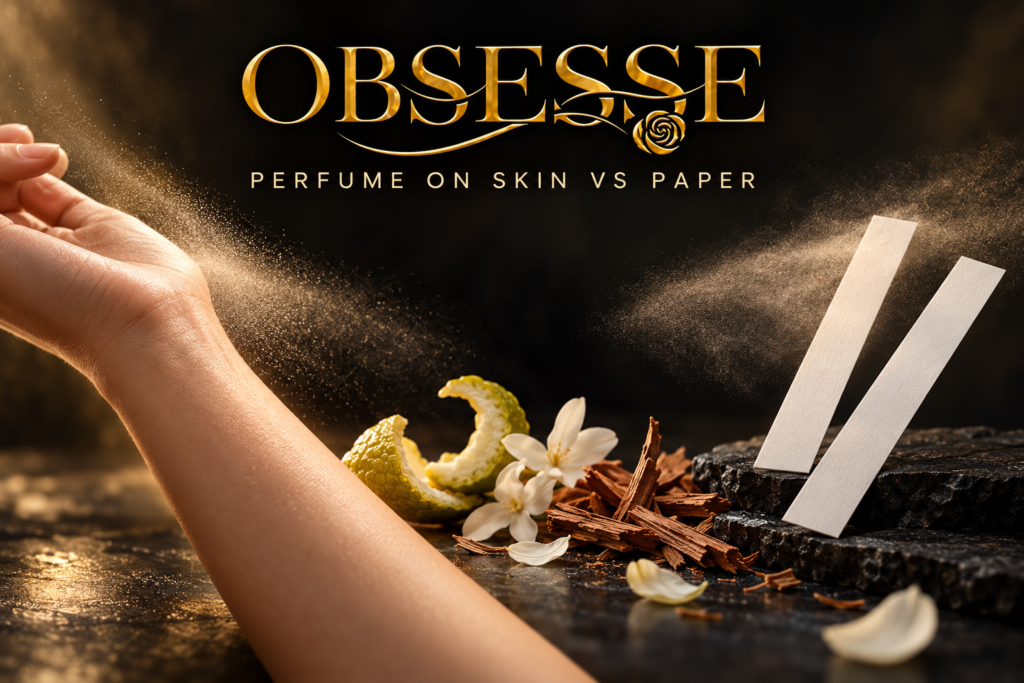
A blotter can help you compare openings and remove obvious mismatches. Skin testing answers the more important question: how does the perfume develop when you wear it?
Try one or two serious candidates at a time. Apply a modest amount to separate areas, avoid rubbing, and note the perfume at the opening, after the first transition, and later in the dry-down. Smelling too many options in quick succession makes comparison harder.
Our step-by-step perfume testing guide explains how to organise the process before committing to a full bottle.
5. Judge the whole wear, not only the first minute
The first spray can be vivid and attractive, but it is only one stage. Ask whether you still like the scent once the brightest materials settle. Notice whether the heart feels balanced and whether the dry-down remains comfortable when it is close to your skin or clothing.
Also separate three different questions: how far the scent projects, the trail it leaves, and how long you can detect it. Our guide to projection, sillage and longevity explains why these are not interchangeable.
6. Use a simple scorecard
After each wear, score the perfume from one to five on:
- Enjoyment: Do I genuinely like smelling it?
- Comfort: Does it become tiring, sharp or overly sweet?
- Fit: Can I wear it in the situations I actually face?
- Versatility: Does it work across more than one setting or season?
- Dry-down: Do I like the final stage as much as the opening?
A scent with a dramatic opening but a poor comfort score is rarely the best everyday choice. A quieter perfume that performs well across all five questions may be a better match.
Four unisex scent directions to explore
These are illustrative profiles, not descriptions of specific Obsesse Fragrance products.
Citrus, tea and light woods
This direction can feel crisp and composed. Citrus provides lift, tea can add a dry or gently aromatic quality, and light woods give the fragrance a calmer base. It is worth exploring for daytime use if you dislike heavy sweetness.
Green leaves, herbs and vetiver
A green aromatic profile may suggest crushed leaves, stems or fresh herbs, while vetiver can add an earthy, dry or smoky nuance depending on the composition. Test carefully: “green” can range from soft and natural to very sharp.
Soft floral, musk-like notes and woods
Florals do not have to be ornate. A transparent floral heart over a smooth base can feel clean, understated and easy to share. Check whether the dry-down becomes powdery, creamy or laundry-like, and decide which effect you prefer.
Spices, resin and restrained sweetness
Cardamom, pepper, resinous warmth and a measured sweet note can create depth without relying on a conventional gender code. In hot or humid conditions, start lightly and judge the fragrance outdoors as well as indoors.
Choosing unisex perfume for Indian weather
India does not have one climate. A warm humid afternoon, dry summer heat, monsoon commute and cool northern evening can make the same perfume feel different. Heat can make an applied fragrance seem more noticeable, while enclosed air-conditioned spaces change how close and persistent it feels around others.
Use climate as a testing condition, not as a universal rule. Wear the candidate during the hours when you expect to use it. If it is mainly for commuting and office wear, test it on a normal workday. If it is for celebrations, try it during a similar evening before deciding.
Application also matters. Start conservatively, then adjust on another wear rather than adding multiple sprays immediately. Store the bottle away from direct sun, high heat and repeated temperature swings; our guide to storing perfume in India covers practical locations and habits.
Common mistakes to avoid
- Buying only from the category name: “Unisex” is too broad to predict the smell. Read the family and note description.
- Assuming one ingredient has one gender: Rose, leather, vanilla, woods and spices can appear in many styles.
- Testing only the opening: The perfume you live with is largely the heart and dry-down.
- Equating strength with quality: A strong perfume is not automatically a better perfume. Suitability and comfort matter.
- Copying another person’s result: Their routine, environment and preferences may differ from yours.
- Overapplying during a test: Too much fragrance can hide whether the profile itself is balanced for you.
A practical buying checklist
Before you purchase, confirm that you can answer yes to most of these:
- I can describe the scent in my own words.
- I have smelled more than the first few minutes.
- I like the dry-down on my skin.
- The perfume fits at least one real use case in my week.
- I know whether I prefer a close scent or a more noticeable one.
- I have tested a modest application in relevant weather.
- I am choosing it for the smell, not because the label tells me who should wear it.
If you prefer to compare before buying a larger bottle, Obsesse Fragrance currently lists an 8 ml single tester bottle option and an 8 ml five-piece tester option. Check the product pages for current details and availability, then use the same testing method for each candidate.
Frequently asked questions
Can anyone wear a unisex perfume?
Yes. The category is intended to be open to any gender. Personal preference, comfort and context are more useful selection criteria than identity labels.
Is unisex perfume always fresh or light?
No. A unisex perfume may be citrus-led, floral, woody, spicy, amber-style, sweet, smoky or a blend of several directions. “Unisex” describes positioning, not one smell or strength.
Are floral perfumes only for women and woody perfumes only for men?
No. Florals and woods are materials or scent directions that perfumers can combine in many ways. Their effect depends on the full composition, not a fixed gender rule.
How should I test a unisex perfume?
Use a blotter for initial comparison, then test serious candidates on skin. Follow the opening, heart and dry-down over several hours, ideally in the setting and weather where you plan to wear the scent.
Can a couple share the same perfume?
Yes, if both people enjoy it. The fragrance may develop or be perceived somewhat differently on each person, so each wearer should test it independently and choose an application amount that suits them.
What is the best unisex perfume for daily wear?
There is no single best option for everyone. A good daily choice is one you enjoy throughout the dry-down, can apply comfortably in your regular spaces, and can wear in the conditions you commonly encounter.
Final takeaway
Unisex perfume gives you permission to begin with smell instead of category. Define the mood you want, explore the relevant fragrance families, test on skin, and judge the complete wear in your real environment. When a scent feels natural in your routine and you look forward to wearing it, the label has already done all the work it needs to do.