To choose a signature scent, begin with the life you actually live—not a list of fashionable notes. Decide where you will wear the fragrance, shortlist a few scent styles you naturally enjoy, test each candidate on skin across several days, and compare the full drydown rather than only the opening. The best signature scent is the one you still enjoy after repeated wear and can use comfortably in your usual settings.
A signature scent is simply a fragrance you wear often enough to feel recognisably yours. It does not have to be your only perfume, the strongest perfume in the room, or a scent you keep forever. For readers in India, a useful choice also needs to work across commutes, warm weather, air-conditioned rooms, workdays and social occasions. This guide explains how to choose a signature scent without relying on hype, packaging or one hurried test.
What makes a perfume a good signature scent?
A good signature fragrance sits at the intersection of four things: personal enjoyment, everyday comfort, practical versatility and a drydown you genuinely like. Compliments can be pleasant, but they are not a reliable substitute for your own judgement. You will live with the scent more closely and more often than anyone around you.
Think of “signature” as a pattern of use rather than a permanent label. Some people keep one perfume for most occasions. Others have a small rotation—perhaps one easy daytime fragrance and one richer evening option. Both approaches are valid. The goal is consistency without forcing yourself to wear something that does not suit the day.
1. Start with your routine, not fragrance terminology
Before comparing bottles, write down the situations that make up most of your week. An office-based buyer who travels by metro needs a different kind of everyday fit from someone who works outdoors, attends frequent celebrations or mainly wears perfume in the evening.
Ask yourself:
- Will I wear this mainly to work, college, social events or everywhere?
- Am I usually in shared spaces, public transport or air-conditioned rooms?
- Do I want a quiet personal scent or something more noticeable?
- Would I rather reapply a light fragrance or wear a fuller scent once?
- Do I need one versatile choice, or am I comfortable keeping separate day and evening options?
This short exercise keeps your search practical. A perfume can smell beautiful and still be a poor everyday match if you consistently find it too rich for your workplace or too delicate for the occasions when you want to wear it.
2. Identify the scent styles you return to
You do not need to become a perfumer, but recognising patterns helps. Look at fragrances, soaps, candles or natural smells you already enjoy. Do you repeatedly choose citrus brightness, clean aromatic herbs, airy florals, warm woods, sweet vanilla-like effects, spices or resinous depth?
Then use note lists as clues, not guarantees. A note is part of a fragrance description; it is not always a literal ingredient, and two perfumes that mention the same note can smell very different because of their overall composition. Our guide to perfume notes explains how top, heart and base notes describe the way a scent develops.
If you are unsure of your preferences, begin with contrasts. Compare one fresh or aromatic scent, one floral or softly sweet scent, and one woody or warm scent. Your reactions to those broad directions will teach you more than reading dozens of similar descriptions.
3. Build a small shortlist
Limit your first comparison to about three candidates. A long row of blotters can make the process confusing, especially when several fragrances share similar structures. A small shortlist makes it easier to notice which scent you keep wanting to smell again.
Choose candidates that meet your main use case, but leave room for one unexpected option. Personal taste is not always predictable from labels such as “for men,” “for women,” “fresh” or “intense.” Fragrance preference is individual, so let the smell and the wearing experience matter more than the marketing category.
It is also sensible to set a budget before testing. That prevents price from becoming an afterthought and helps you judge the complete purchase: how often you expect to wear it, whether the bottle size suits you, and whether you would be comfortable repurchasing it.
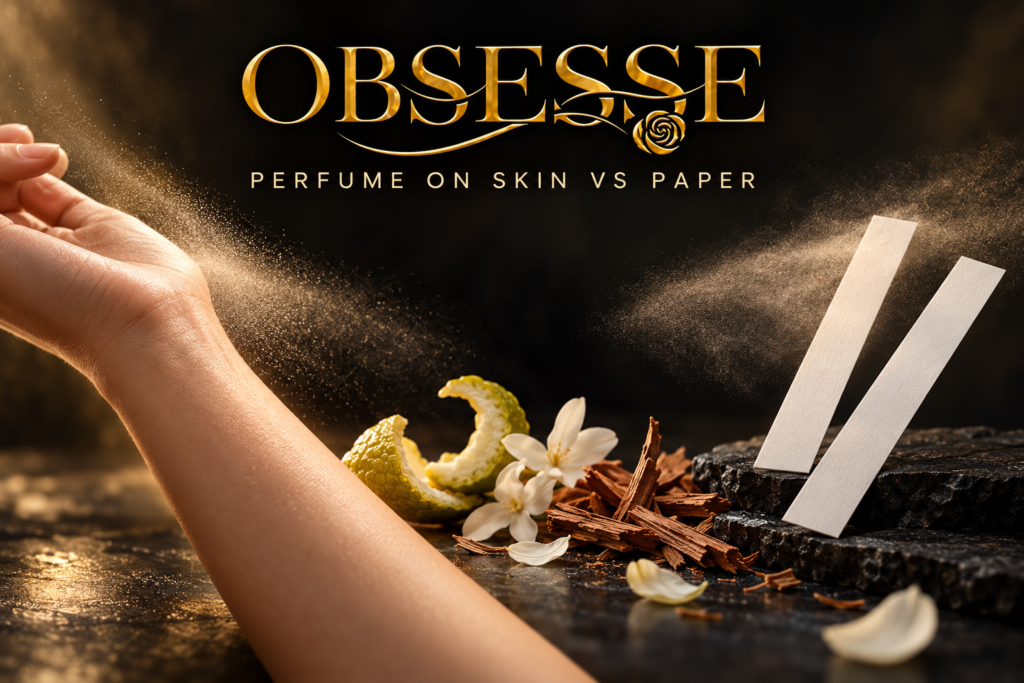
4. Test on paper first, then on skin
Use a scent blotter for the first screening. It helps you reject an obvious mismatch without filling your arms with fragrances. Label each strip, keep them apart and revisit them after the opening settles.
Move only the most promising candidates to skin. The Aesop fragrance guide recommends sampling on skin on different occasions and allowing a fragrance to evolve; it also advises limiting a comparison to two scents at a time so aromas do not become muddled. Its explanation of top, heart and base notes reinforces why an opening impression is only part of the story.
Apply one candidate to each wrist or inner arm, following the product directions. Do not rub the application points together. Then carry on with your day. If you have sensitive skin or a history of fragrance reactions, follow the label, avoid applying to irritated skin and discontinue use if discomfort occurs.
For a fuller method, use our step-by-step guide on how to test perfume before buying.
5. Judge the opening, heart and drydown separately
A fragrance changes after application. The opening may feel sparkling or vivid, while the heart reveals the main character and the base becomes clearer later. Your signature choice should not depend on the first five minutes alone.
Use simple checkpoints rather than trying to name every note:
- At the start: Is the opening pleasant, harsh, too sweet or immediately comfortable?
- After 30–60 minutes: Do you enjoy the main character as much as the first impression?
- Several hours later: Does the scent remain appealing when it sits closer to the skin?
- At the end of the wear: Would you happily smell this on clothes or skin again tomorrow?
The last question is especially useful. A dramatic opening may win a quick comparison, but a signature fragrance must remain enjoyable after the novelty fades.
6. Test it in the settings where you will wear it
India does not have one climate or one daily routine. Heat, humidity, travel, indoor cooling and personal application habits can all change how a fragrance feels to the wearer. A scent that seems soft in an air-conditioned shop may feel more noticeable on a warm commute. Conversely, a fragrance you barely notice after several hours may still be perceptible to someone nearby.
Test your leading candidate on at least two different days. Ideally, include one ordinary work or study day and one day that resembles your social use. Keep the number of sprays consistent so you are comparing the fragrance rather than the dose.
In a shared office, classroom, cab or lift, comfort matters. A signature scent should not require maximum projection to feel personal. If workplace wear is central to your decision, read our office perfume etiquette guide for India.
7. Separate longevity from projection and sillage
Performance is not one single quality. Longevity is how long you can detect a fragrance. Projection describes how far it seems to radiate at a given time. Sillage is the trail it leaves as you move. A fragrance may last close to the skin without projecting strongly, and that can be an excellent feature for everyday wear.
Decide which behaviour fits your routine. For close workspaces, moderate projection with a comfortable drydown may be more useful than a large scent cloud. For an evening event, you may prefer more presence. Our comparison of projection, sillage and longevity gives you a practical way to test each one.
8. Do not choose by concentration label alone
Eau de Toilette, Eau de Parfum and Parfum are useful format labels, but they do not tell you exactly how a specific formula will perform on you. Composition, application, environment and perception all matter. A higher concentration is not automatically the better signature option if you prefer the balance, freshness or ease of a different version.
Use concentration as one piece of information, then rely on real wear tests. For more context, see EDP vs EDT vs Parfum.
A simple signature-scent scorecard
After each full wear, rate the candidate from 1 to 5 on the criteria below. Add a short note instead of relying on memory.
| Criterion | Question to answer |
|---|---|
| Enjoyment | Do I like the scent from opening through drydown? |
| Comfort | Can I wear it for hours without wanting to wash it off? |
| Routine fit | Does it suit the places and people in my normal week? |
| Versatility | Would I reach for it across several common occasions? |
| Performance fit | Are its longevity and presence appropriate for my needs? |
| Value | Would I wear it often enough to justify the purchase? |
| Confidence | Do I feel like myself when I wear it? |
Do not treat the total as a scientific verdict. The scorecard is a decision aid that reveals trade-offs. If two fragrances finish close, wait a day or two and notice which one you genuinely miss.
Common mistakes to avoid
- Buying after one spray: the opening may not represent the later stages.
- Testing too many at once: similar scents become harder to distinguish.
- Choosing only for compliments: other people’s reactions depend on taste, distance and setting.
- Assuming louder means longer-lasting: projection and longevity are different.
- Following gender labels too rigidly: wear what smells and feels right to you.
- Ignoring ordinary days: a true everyday choice should work beyond parties and special occasions.
- Forcing a forever decision: tastes, routines and climates change.
Should you have one signature scent or a small wardrobe?
One fragrance is enough if it covers your needs and you enjoy the simplicity. A small wardrobe is equally reasonable if your settings vary. You might keep one easy daytime scent, one evening scent and one seasonal or celebratory option.
You can also change a signature over time. Moving cities, changing work environments or simply developing new preferences are all good reasons to reassess. Consistency should feel natural, not restrictive.
If you enjoy combining fragrances, first learn each one on its own. Then use the measured approach in our perfume layering guide; layering adds variables and is easier once you understand the individual drydowns.
Try before committing to a full bottle
A smaller format gives you time to experience a fragrance in real conditions. Obsesse Fragrance currently lists an 8 ml single tester bottle and an 8 ml five-piece tester option. Check the live product pages for current selection, price and availability before ordering.
Use testers as a personal trial, not a race to find an instant winner. Wear each option alone, keep brief notes and let repeat enjoyment decide.
Frequently asked questions
How long should I test a perfume before choosing it as my signature scent?
Test a leading candidate on at least two separate days and experience the opening, heart and drydown each time. More wears are helpful when the fragrance is expensive, unfamiliar or intended for frequent use.
Can a signature scent be used for every occasion?
It can be versatile without being universal. If it feels too rich for work or too quiet for celebrations, keep a second option rather than forcing one fragrance into every setting.
Is Eau de Parfum always best for a signature scent?
No. EDP is a concentration category, not a guarantee of better smell, comfort or performance. Choose the version whose full wearing experience suits you.
Should a signature scent be strong?
Not necessarily. A close, comfortable scent can be more practical for daily use than one with strong projection. The appropriate level depends on your environment and preference.
Can men and women choose from the same fragrance styles?
Yes. Marketing categories can help organise a range, but they do not determine personal taste. Evaluate the scent on your skin and in your routine.
What if I love a perfume in winter but not in hot weather?
Keep it as a seasonal option and choose a second scent for warmer conditions. A signature can be seasonal rather than year-round.
When should I change my signature scent?
Change it when your tastes, lifestyle or wearing conditions change—or simply when you stop enjoying it. A signature scent is personal; it is not a lifetime contract.
The final decision
The most reliable answer to how to choose a signature scent is to make the decision slowly and in context. Define your routine, explore a few scent directions, test on skin, live with the drydown and compare practical fit as well as beauty. When one fragrance repeatedly feels comfortable, useful and unmistakably right for you, you have found a strong signature candidate.