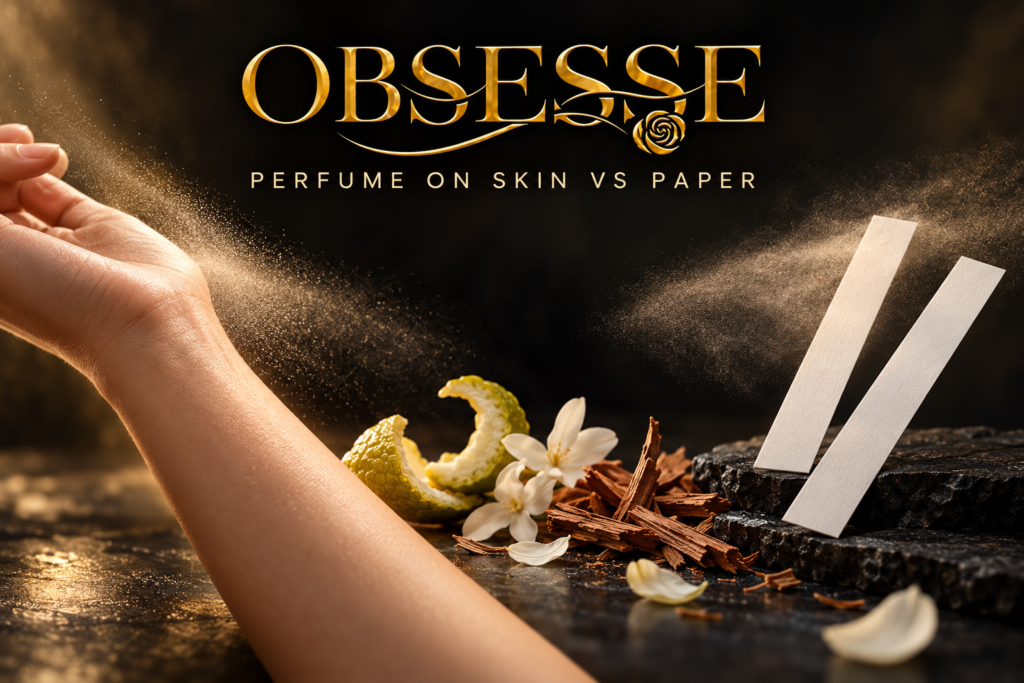
Perfume projection, sillage and longevity describe three different parts of fragrance performance. Projection is how far the scent reaches from you at a particular moment. Sillage is the trail it leaves in the air as you move. Longevity is how long it remains detectable after application. A perfume can perform strongly in one area and quietly in another, so these terms should not be used as if they mean the same thing.
For example, a fragrance may project noticeably during its opening but settle close to the skin while remaining detectable for hours. Another may create a graceful trail when you walk without filling the space around you when you are seated. Understanding perfume projection vs sillage helps you read reviews more critically, test perfume more accurately and choose a scent that suits your real routine in India.
Projection vs sillage vs longevity at a glance
| Term | The question it answers | Simple example |
|---|---|---|
| Projection | How far does the scent radiate from the wearer right now? | Can someone nearby notice it while you are standing still? |
| Sillage | What scent trail does it leave as the wearer moves? | Does a trace remain briefly after you walk past? |
| Longevity | How long does the fragrance remain detectable? | Can it still be smelled close to the application area later? |
These descriptions are practical fragrance vocabulary, not standard laboratory scores printed on every bottle. Reviews often use words such as soft, moderate or strong, but one reviewer’s “moderate” can be another person’s “noticeable.” Use reviews to create a shortlist, then test the fragrance yourself.
What is perfume projection?
Projection is the scent’s present reach around the wearer. Imagine an invisible fragrance bubble. Stronger projection means the scent can be detected from farther away; softer projection means someone usually needs to be closer.
Projection is not constant. The first part of a fragrance can feel more expansive because many opening materials evaporate readily. As the scent develops, its reach may reduce even though it is still clearly present on the skin. That change is normal and is one reason a single comment such as “projects well” needs a time reference.
When evaluating a review, ask:
- Was the reviewer describing the first few minutes or the later dry-down?
- How much did they apply, and what kind of atomiser did they use?
- Were they indoors, outdoors or in moving air?
- Were they judging their own perception or feedback from another person?
A perfume does not need maximum projection to be useful. Soft projection can be more comfortable for close conversations, offices, classrooms, shared transport and family gatherings. Strong projection may suit some outdoor or celebratory settings, but application and other people’s comfort still matter.
What is perfume sillage?
Sillage is the trail of fragrance that follows a wearer through space. The word comes from French and can refer to the wake left by a boat. In perfumery, it describes the scented trace noticed after someone moves past or leaves an area.
Aesop’s updated guide to fragrance describes sillage as the trace remaining after the wearer has moved through a room. In casual conversation, people sometimes use “sillage” and “projection” interchangeably. Keeping them separate is more useful: projection is the current radius; sillage is the moving trail.
Sillage depends on more than the formula. Movement, airflow, application location, clothing and the stage of wear can affect what others notice. A scent that seems quiet while you sit may leave a clearer trail when you walk. Conversely, a fragrance can feel noticeable nearby without leaving much behind.
What is perfume longevity?
Longevity is the length of time a fragrance remains detectable after application. It does not tell you how far the scent travels. A perfume can have long longevity but remain close to the skin, or it can project strongly at first and then fade relatively quickly.
Define the endpoint before comparing two fragrances. “Still detectable when I smell the application area closely” is different from “still noticeable to another person across a table.” Both observations can be valid, but they measure different experiences.
Aesop notes that longevity is influenced by factors such as heat, molecular volatility and application quantity. The formula itself matters greatly, which is why an exact hour claim should not be copied from one person’s test and treated as a promise for everyone.
Can projection, sillage and longevity be different?
Yes. They frequently are. Consider three hypothetical performance profiles:
| Performance profile | What it may feel like | Where it may suit |
|---|---|---|
| Strong opening projection, shorter wear | Noticeable at first, then becomes quiet relatively quickly | A brief outdoor occasion, if applied considerately |
| Soft projection, longer longevity | Stays close but can be detected on skin for a long time | Office days, travel or close social settings |
| Moderate projection with noticeable sillage | Comfortable nearby, with a clearer trail during movement | Dinners, celebrations or events with more space |
These are patterns, not rankings. The right choice depends on where you will wear the fragrance and how you want it to behave. “More” is not automatically better.
Does EDP or Parfum always perform better?
No. Concentration labels are useful, but they do not guarantee a specific projection, sillage or longevity result. Eau de Parfum generally contains more fragrance material than Eau de Toilette, while Parfum usually belongs to a higher concentration range. The ranges overlap, and formulas can emphasise different notes or use materials with different diffusion.
A higher concentration may last longer yet remain closer to the skin. A lighter concentration may create a bright, expansive opening. Read our guide to EDP vs EDT vs Parfum for the typical concentration ranges and why the complete formula matters more than assuming a label is a performance grade.
Why you may stop smelling your own perfume
Not noticing your fragrance does not always mean it has disappeared. Continued exposure to an odour can reduce your responsiveness to it, a process studied as olfactory adaptation. A review indexed by the US National Library of Medicine reports that adaptation can raise odour-detection thresholds and reduce responsiveness during ongoing stimulation. See the research summary on olfactory adaptation.
This is why repeatedly adding more perfume can be misleading. Other people may still detect it even when your own perception has softened. Before reapplying, step into fresh air, wait, check the application area at close range or ask one trusted person for neutral feedback. Do not use a colleague or stranger as an unplanned performance test.
How to test projection accurately
- Use a familiar environment. Test at home where you are not exposing a crowd to a new fragrance.
- Record the application. Note the time and follow the product directions instead of using an arbitrary spray target.
- Allow the opening to settle. Judge at more than one stage, not only immediately after spraying.
- Use neutral feedback. Ask a willing person how close they need to be to notice it, without telling them the answer you expect.
- Repeat on another day. One wear can be influenced by temperature, airflow and attention.
Do not turn distance into a competition. The useful question is whether the projection suits the intended situation.
How to test sillage
Sillage is difficult to judge from your own stationary position because it concerns the trail behind movement. Ask a trusted person to help in a clean, familiar space. After the fragrance has settled, walk past at a normal pace and ask whether a brief trail is noticeable. Avoid spraying the room; that would measure ambient fragrance rather than your wear.
Repeat the check later in the dry-down. A strong opening trail may become subtle, while some base materials remain noticeable with movement. Keep the feedback descriptive—“noticeable only as you passed” is more useful than a dramatic score with no context.
How to test longevity
Apply according to the label, note the time and check the fragrance at sensible intervals. Smell close to the application area rather than expecting room-filling projection throughout the day. Record when the scent becomes faint and when you can no longer detect it.
For a fair comparison, test candidates on separate days in similar conditions. Do not compare one fragrance on fabric with another on skin, because those are different surfaces. Our detailed guide on how to test perfume before buying covers blotters, skin testing and the dry-down process.
How Indian weather and daily routines affect performance
India contains many climates, and a single day may include a warm walk, an air-conditioned metro or cab, a lift and a cool office. Heat can increase evaporation and make an opening feel more noticeable, while enclosed rooms reduce the distance between people. Air movement outdoors can disperse scent quickly even when the fragrance remains on the skin.
Use your actual routine as the standard:
- Office or classroom: prioritise controlled projection over a large scent radius.
- Metro, cab or carpool: remember that passengers cannot easily move away from a strong fragrance.
- Outdoor event: check how the perfume behaves in warmth, but do not compensate automatically with excessive application.
- Wedding or celebration: consider the venue, crowd density and duration rather than assuming every event needs strong sillage.
- Air-conditioned day: do not mistake your own adaptation for poor longevity.
For shared workplaces, see our office perfume etiquette guide. It explains why discreet application and avoiding desk-side reapplication matter more than chasing maximum performance.
Common mistakes when judging perfume performance
Assuming strong projection means high quality
Projection is a behaviour, not a quality certificate. A carefully made fragrance can be intentionally intimate, while a loud opening does not prove refinement or balance.
Using one fixed spray count for every bottle
Atomisers release different amounts, and formulas diffuse differently. Follow the product directions and start conservatively.
Testing several fragrances together
Multiple scents can overlap and make the result difficult to identify. Use labelled blotters and limit skin comparisons.
Judging only from compliments
A compliment depends on social context, distance and the observer’s taste. It is not an objective measurement of longevity or quality.
Confusing a skin scent with a vanished scent
A fragrance that is detectable only close to the skin still has longevity; it simply has low projection at that stage.
Reapplying because you became accustomed to it
Check for adaptation and seek neutral feedback before adding more, particularly in enclosed spaces.
How to explore performance with Obsesse Fragrance
Obsesse Fragrance offers individual perfume pages and tester formats for shoppers in India. This article does not assign performance scores or hour claims to any Obsesse scent because the current product pages do not publish verified projection, sillage or longevity measurements.
If you want to compare fragrances in your own routine, check the current details for the single 8 ml tester bottle or the five-piece 8 ml tester option. Availability, selection and pricing can change, so confirm them on the live product pages. Test each scent on separate days and record what you actually observe.
Frequently asked questions
What is the main difference between perfume projection and sillage?
Projection is how far a perfume reaches around you at a given moment. Sillage is the scent trail it leaves as you move through a space.
Can a perfume have good longevity but weak projection?
Yes. It may remain detectable close to the skin for a long time while creating only a small scent radius.
Does strong sillage mean the perfume lasts longer?
Not necessarily. A noticeable trail describes movement through air, while longevity describes duration. One does not guarantee the other.
Why can other people smell my perfume when I cannot?
Your response can decrease after continuous exposure because of olfactory adaptation. Other people entering the scent later have not had the same continuous exposure.
How much projection is appropriate for work?
Usually, a restrained personal scent bubble is more considerate than a fragrance detectable across the room. Follow workplace rules and adjust if someone raises a concern.
Does hot weather improve perfume performance?
Heat can make evaporation and the opening feel more noticeable, but it does not guarantee better longevity or a more pleasant result. Test conservatively in your real conditions.
Are online performance ratings reliable?
They are useful as opinions, not promises. Look for reviews that mention application, timing, climate and setting, then verify with your own wear test.
The practical takeaway
In the perfume projection vs sillage comparison, remember radius versus trail; add longevity as the separate measure of time. Judge all three at multiple stages, account for olfactory adaptation and choose performance that fits your environment. A fragrance that stays close and comfortable can be more useful than one that dominates the room.