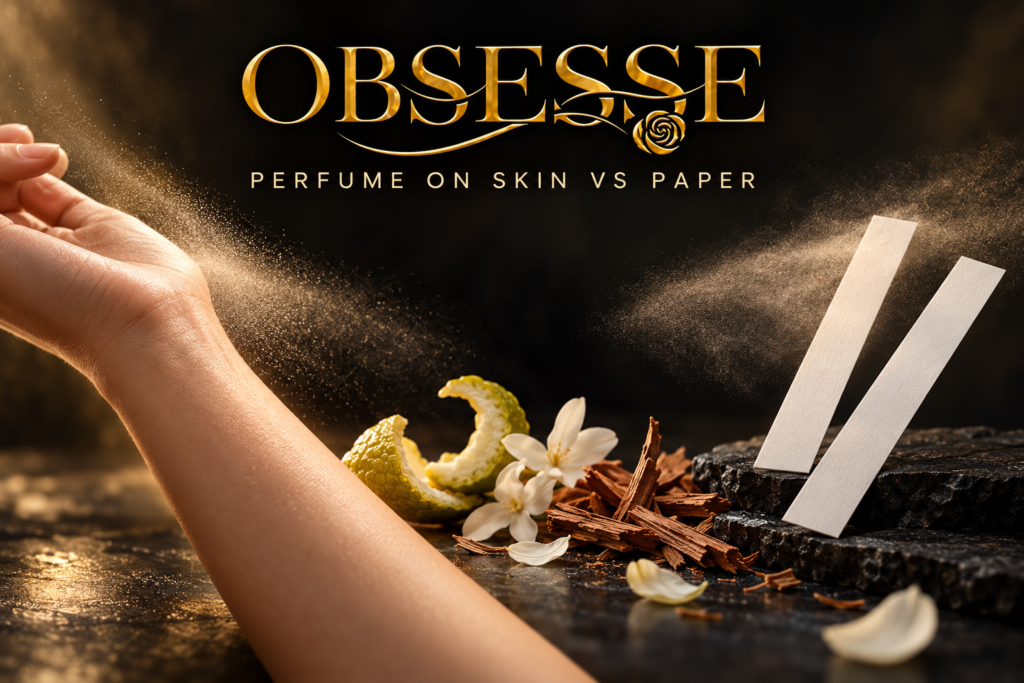
Perfume layering means wearing two or more fragrances together to create a combined scent. The safest way to begin is simple: choose two perfumes you already understand, compare them on labelled blotters, test a small combination on skin, and keep the total application conservative. Layering should help you discover a combination you enjoy—not create the strongest possible scent.
A useful perfume layering guide also needs to explain what not to do. Do not pour different perfumes into the same bottle, assume every popular pairing will suit your skin, or double your normal application without considering the people around you. Fragrance formulas are finished products with their own directions; experimentation should happen when you wear them, not by altering the contents.
What is perfume layering?
Perfume layering, also called scent pairing or fragrance combining, is the practice of applying more than one scent so their profiles are experienced together. You might pair two spray perfumes, or combine a fragrance with a separately labelled scented body product when both products are intended for that use.
Jo Malone London describes scent pairing as layering more than one scent to create something personal, while The Perfume Society’s layering guide recommends beginning with a fragrance you already like and understanding its notes. These are useful starting ideas, but they are not universal formulas. Products from different brands are not necessarily designed as a coordinated layering system.
Layering is optional. A professionally composed perfume already contains many materials and accords balanced by a perfumer. Wearing it alone is not incomplete. Layer only when the experiment adds enjoyment, variety or a new emphasis that you genuinely prefer.
What perfume layering is not
- It is not bottle mixing. Do not decant two perfumes into one container. You could change the stability, spray performance and traceability of both finished products.
- It is not a performance shortcut. Two fragrances do not automatically last longer than one, and extra application may only make the opening louder.
- It is not a fixed recipe. “Floral plus woody” describes a broad idea, not a guaranteed result.
- It is not a reason to ignore directions. Follow each product’s label, intended use and warnings.
- It is not limited by gender labels. Notes and scent families can be explored according to your taste rather than the shelf on which a product is marketed.
Before layering, learn each fragrance on its own
You cannot tell what a combination changed if neither perfume is familiar. Wear each candidate separately on different days. Notice the opening, the middle and the dry-down. Record what you actually smell rather than relying only on the marketing description.
Our article on top, heart and base notes can help you read a fragrance description, but remember that a note list is not a full formula. Two perfumes that both mention vanilla, rose or sandalwood can still behave very differently.
Concentration matters too, though it cannot predict the outcome by itself. An EDT, EDP and Parfum may differ in both strength and note balance. Read EDP vs EDT vs Parfum before assuming that the higher concentration should always be the first or dominant layer.
A practical perfume layering method
Step 1: Choose one clear goal
Decide what you want the second fragrance to do. Are you trying to make a sweet scent feel fresher, give a light citrus more warmth, soften a sharp woody profile or simply create variety? A clear goal is easier to evaluate than combining two bottles because both smell good separately.
Step 2: Start with only two fragrances
Two perfumes give you enough contrast while keeping the result understandable. Three or four at once make it difficult to identify which element is creating sweetness, dryness, heaviness or conflict. You can explore further after finding one reliable pair.
Step 3: Use labelled blotters first
Spray each perfume onto its own blotter according to its directions and label the strips. Smell them separately, then hold the strips near each other without touching your nose to them. This lets you preview the relationship without committing it to your skin.
Wait beyond the first minute. A bright opening may work beautifully and then change as the heart and base develop. Revisit the blotters after a reasonable interval and again later in the day. If the combination becomes muddy, harsh or tiring, you have learned something without overloading your skin.
Step 4: Test conservatively on skin
If the blotter pairing remains pleasant, try it on a low-stakes day. Follow both labels and begin with a light total application. You can place the fragrances on nearby areas to understand how they mingle in the air, or layer them on the same permitted application area if the product directions allow it.
There is no universal rule about which scent must go first. Some guides suggest beginning with a heavier fragrance and adding a lighter one; others use the lighter scent as the base. The formula, spray volume and your goal matter more than a slogan. Test both orders on different occasions rather than applying more in one session.
Step 5: Keep simple notes
Write down the two fragrances, order, location, time and your impression at the opening, middle and dry-down. “One felt much stronger” is more useful than an invented exact ratio if the atomisers release different amounts. Your notes make successful combinations repeatable and prevent you from retesting an uncomfortable pair.
Beginner-friendly pairing ideas
These are directions to explore, not promises. Test the complete perfumes because the unlisted materials and overall balance matter.
| Starting fragrance | Second direction to test | What to observe |
|---|---|---|
| Citrus or fresh profile | Soft woods or a clean musk style | Does the base add structure without hiding the brightness? |
| Floral profile | Citrus, gentle woods or a restrained musk style | Does the pairing clarify the floral character or make it crowded? |
| Sweet or gourmand profile | Dry woods, aromatic notes or a fresher profile | Does the contrast create balance, or does it become too dense? |
| Woody profile | Citrus, green or soft floral direction | Does the second scent lift the composition while preserving the base? |
| Two related scents | A shared note or family | Does the common element connect them, or simply amplify one facet? |
Similarity often makes an easy first experiment because a shared note can act as a bridge. Contrast can be more interesting, but it needs more careful testing. Neither approach is objectively better.
How to avoid an overpowering combination
Layering combines the presence of both products. Keep the total effect in mind rather than treating each fragrance as if it were being worn alone. A familiar perfume can become much more noticeable when another composition adds diffusion or reinforces its base.
- Begin with less total fragrance than your usual combined amount.
- Do not reapply simply because your own nose has adapted.
- Test at home before wearing the combination on public transport or into a meeting.
- Avoid spraying in lifts, cabs, workstations or other shared spaces.
- If someone says the combination is strong, reduce it without arguing about the individual perfumes.
For professional settings, the principles in our office perfume etiquette guide still apply. A creative combination should remain within your personal space rather than becoming part of the room.
Layering perfume in Indian weather
India includes hot, humid, dry, cool and heavily air-conditioned environments, sometimes within the same day. A combination tested in a cool bedroom may feel different after a warm commute and then again inside a closed office. Do not assume that “summer” always requires citrus or that “winter” always requires sweet scents. Use the weather and setting as test conditions, not rigid style rules.
On a warm day, begin conservatively and give the perfumes time to settle before entering shared transport. During the monsoon, consider how the scent feels in humid outdoor air and enclosed interiors. For an evening event, test the complete dry-down in advance instead of creating a new combination just before leaving.
Store both bottles correctly between uses. Layering does not change the basic need to protect fragrance from excessive heat and direct light. Our guide to storing perfume in India explains practical care at home and while travelling.
Safety and skin comfort
Use every fragrance only as its label directs. Do not apply to eyes, broken or irritated skin, or any area the instructions exclude. If a product causes discomfort, stop using it and seek appropriate medical advice when needed. A combination that smells pleasant is not proof that every individual ingredient is suitable for every person.
The International Fragrance Association Standards provide an industry risk-management framework for fragrance ingredients and intended product uses. IFRA also makes clear that conformity documentation does not replace a finished product safety assessment. For a consumer, the practical rule is to use genuine finished products as directed and avoid DIY alterations with raw fragrance materials or essential oils.
If a household member or colleague reports fragrance sensitivity, treat the concern respectfully and simplify or stop the combination around them. Layering is a personal style choice, not a need that overrides someone else’s comfort in a shared environment.
Common perfume layering mistakes
Choosing by note name alone
A shared word such as rose, amber or vanilla does not guarantee compatibility. The strength, supporting materials and style of the two compositions can be very different.
Testing only the opening
A combination that sparkles for five minutes may become dense later. Evaluate the heart and base before calling it successful.
Using a fixed spray ratio
Atomisers release different amounts and formulas project differently. “One plus one” is not an exact measurement across bottles. Start conservatively and judge the actual result.
Covering a fragrance you dislike
Layering rarely turns an unwanted full bottle into a guaranteed favourite. Test first rather than buying another perfume solely to rescue it.
Mixing the liquids together
Keep each fragrance in its original bottle and packaging. This preserves identification, directions and the formula as sold.
How to explore layering with Obsesse Fragrance
Obsesse Fragrance offers individual perfume pages and tester formats for shoppers in India. This guide does not claim that any specific Obsesse pairing is officially designed or guaranteed to layer well, because the current product pages do not publish verified pairing instructions.
A smaller format can make personal comparison more manageable. Check the current details for the single 8 ml tester bottle or the five-piece 8 ml tester option. Selection, availability and price may change, so confirm everything on the live product page. Test each scent independently before combining any two.
Frequently asked questions
Can I layer any two perfumes?
You can test many finished fragrances together, but not every pair will smell balanced or feel comfortable. Check both labels, compare on separate blotters and proceed conservatively.
Which perfume should I apply first?
There is no universal order. A heavier-first approach is one experiment, while a lighter base is another. Test one order at a time and evaluate the complete dry-down.
How many perfumes should a beginner layer?
Start with two. This keeps the experiment understandable and makes it easier to repeat or adjust.
Should I spray both perfumes on the same spot?
You may compare them on nearby permitted areas first, which helps you understand each contribution. If the labels allow skin application, you can later test them on the same area with a conservative total amount.
Can layering make perfume last longer?
It may change how long some facets remain noticeable, but it is not guaranteed. Longevity depends on the formulas, environment, application and perception.
Can I mix perfumes in one bottle?
No. Keep the liquids in their original containers. Mixing them changes the finished products and makes the result difficult to reverse or evaluate safely.
Is perfume layering suitable for the office?
It can be, if workplace rules allow fragrance and the total effect remains subtle. Test beforehand, avoid reapplying at your desk and adjust immediately if someone raises a concern.
The simplest way to start
A thoughtful perfume layering guide does not need a long list of “perfect” combinations. Learn two fragrances separately, define what you want to change, compare them on labelled blotters and wear-test the pair conservatively. Keep the bottles separate, respect product directions and shared spaces, and repeat only the combinations that make your own fragrance routine more enjoyable.