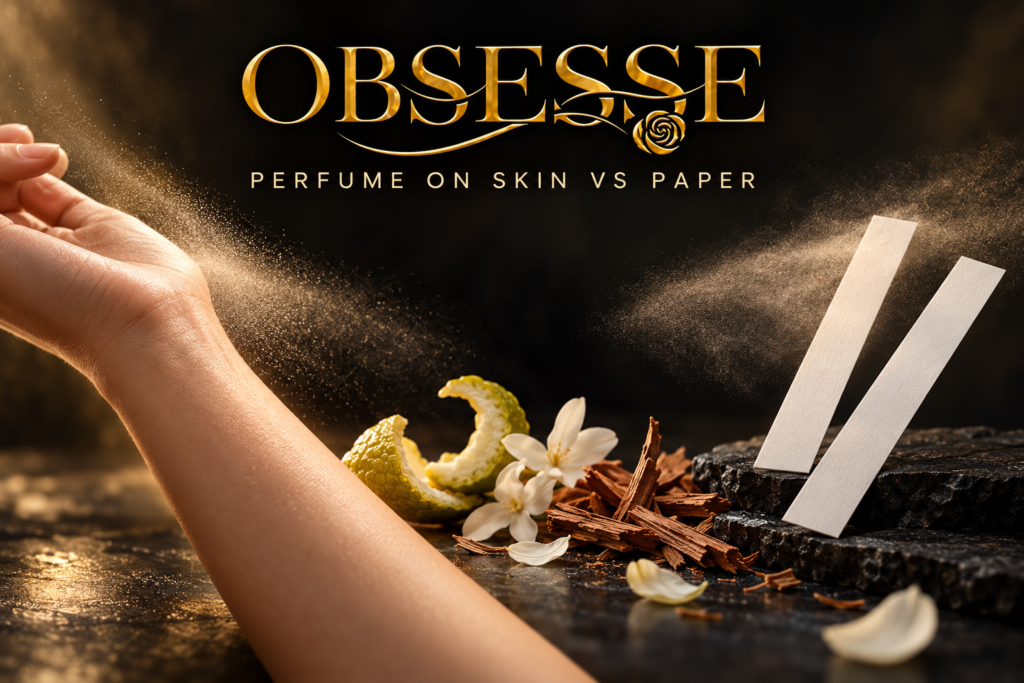
Perfume notes are the scent impressions used to describe a fragrance. Top notes introduce it, heart or middle notes describe its central character, and base notes help describe the lasting impression. Read them together rather than choosing a bottle because one favourite word appears in the list. A note pyramid is a useful guide to explore, not a complete preview of what you will smell.
If an online description mentions bergamot, jasmine and cedarwood, you may recognise the names without knowing whether the perfume is for you. That is a sensible place to start. This Obsesse Fragrance guide makes the vocabulary easier to use, with a worked example and practical questions for shoppers in India.
Perfume notes explained: top, heart and base
The International Fragrance Association’s introduction to fragrance creation describes an opening, a middle that gives the scent body, and a base that provides depth. Think of these as connected parts of a composition.
| Term on the page | What it describes | Useful question |
|---|---|---|
| Top or opening notes | The initial impression | Does the opening interest me? |
| Heart or middle notes | The central character | Does this sound like a direction I enjoy? |
| Base notes | The foundation and lingering impression | Am I interested in how the fragrance settles? |
Jo Malone London’s explanation of perfume notes uses citrus and herbs as examples of opening notes, floral, fruity or spicy impressions for the heart, and woods, musk or vanilla for the base. These examples help explain the vocabulary; they are not a formula for every perfume.
For shopping, the important habit is to read beyond the opening. If you love a citrus description but hesitate over the rest of the composition, keep that hesitation in your notes. You do not have to decide from the most immediately appealing word.
What is the difference between a note and a fragrance family?
A note is a more specific scent reference, such as mandarin or cedarwood. A family is a broader way to organise fragrances. Jo Malone London’s fragrance-family guide, for example, groups its collection into citrus, fruity, light floral, floral, spicy and woody directions.
Use a family label as a browsing tool. If woody descriptions repeatedly interest you, that section can help you find candidates. Then read the individual product information. A family name does not tell you everything about sweetness, intensity or how much you will enjoy wearing a particular bottle.
You might keep two separate lines in a shopping note: “direction I want to explore” and “specific notes that caught my attention.” This separates a broad preference from a single attractive detail. It also gives you a clearer question to ask a seller.
Do listed notes tell you the ingredients?
Do not treat a short scent description as the complete formula. IFRA explains that perfumers work with natural materials and synthetic fragrance materials. Its fragrance questions page also explains that “fragrance” or “parfum” can represent a mixture on an ingredient label.
The practical distinction is between information about the smell and information supplied about the product’s composition. Read both where available. If you need to establish whether a particular material is present, ask the brand directly rather than making the decision from a rose photograph or a note list.
Likewise, do not turn the words “natural,” “premium” or “luxury” into proof of a specific formula. Save the exact product details you are considering so that any question can be answered about that version, not about perfume in general.
A worked example: reading a fictional perfume description
Imagine a listing that says:
- Opening: mandarin
- Heart: rose
- Base: cedarwood
This is a fictional learning example, not an Obsesse product description. It gives you three reference points to explore. Start by asking which part attracted you. Perhaps the mandarin sounds appealing, but you have not tried many rose-led descriptions. That makes the heart a useful point to investigate, not a reason to reject the perfume automatically.
Next, turn the description into questions: “Will I enjoy the floral character?” and “Would I choose to wear the settled scent as well as the opening?” Notice what is missing. The list has not told you the price, bottle size, available samples or whether it suits your preferences.
Finally, record your expectation before trying it. Afterwards, compare expectation with experience. “I expected the citrus to be my favourite part, but preferred the later impression” is more useful than trying to prove you detected all three notes correctly.
Read a product page in three passes
First pass: understand the description
Read the opening paragraph and the full note list. Write a plain-language summary in your own words: “I want to explore this floral direction,” for example. If you cannot summarise it, keep the page as a possibility rather than forcing a decision.
Second pass: separate evidence from expectation
Mark what the listing actually states and what you are imagining. “The page lists a woody base” is a product-page observation. “It will be perfect for my office” is an expectation you still need to evaluate. Keeping those apart helps you avoid buying a story instead of choosing a fragrance.
Third pass: check the purchase details
Confirm the exact name, stated version and bottle size. Look for sample options, delivery information and return conditions. If a description is incomplete, a short message to the seller is more useful than borrowing another perfume’s notes because the names sound similar.
Use your routine in India to ask better questions
Instead of searching for one note that is supposedly right for everyone in an Indian summer, describe your actual day. Are you choosing for a shared workspace, an outdoor gathering or occasional evening plans? These are decision contexts, not rules that make one fragrance family compulsory.
For a hypothetical Bengaluru office purchase, your question might be: “Would I enjoy this during a normal workday?” For a Delhi wedding purchase, it could be: “Do I want this scent for this event, or am I buying it only because the description sounds festive?” Neither question can be answered by the word “woody” alone.
Personal references can help you explain preferences, but leave room for differences. Enjoying the smell of a flower at home is a starting point for curiosity, not a guarantee that every perfume mentioning that flower will suit you.
What notes cannot reliably decide for you
- A guaranteed wearing time: do not calculate hours from the number of base notes.
- Your favourite fragrance: a familiar note is a reason to explore, not an obligation to buy.
- Whether two perfumes smell identical: shared words alone do not establish that.
- The best choice for a recipient: their preferences still matter when buying a gift.
When you are ready to move from description to experience, follow our practical guide to testing perfume before buying. It covers comparing options without turning this vocabulary exercise into a rushed full-bottle purchase.
Exploring Obsesse Fragrance with a clearer shortlist
Obsesse lists an 8 ml single tester bottle. Check the current listing and confirm which fragrance you can select before ordering. The small format is an option to investigate, not a promise that every scent or version is available.
Keep your shortlist short enough to explain. One option with a direction you already enjoy and another that makes you curious can give you a purposeful comparison. There is no need to collect a long list of fashionable note names before you begin.
Frequently asked questions
What are top, middle and base notes?
They describe the opening, central character and lasting foundation of a fragrance. Middle notes and heart notes mean the same part of this descriptive structure.
Should I buy perfume for its top notes?
Read the whole description. An appealing opening can make you curious, but consider whether the rest of the fragrance interests you too.
Can a note list replace trying the perfume?
No. Use it to understand the description and form a shortlist. Your own reaction is still necessary to decide whether you want to wear the fragrance.
Are perfume notes a full ingredient list?
No. Do not use a short scent description as a complete formula. Read the product information and contact the brand when you need a composition-specific answer.
What if I cannot identify every note?
You do not need to. Clear observations such as “I enjoy this” or “this is not what I wanted” are enough to make a personal buying decision.
Let the vocabulary help, not overwhelm you
The goal is not to memorise a perfume dictionary. It is to understand enough of a description to ask useful questions. Explore Obsesse Fragrance with that approach: read the full picture, check the details and choose what you genuinely want to wear.